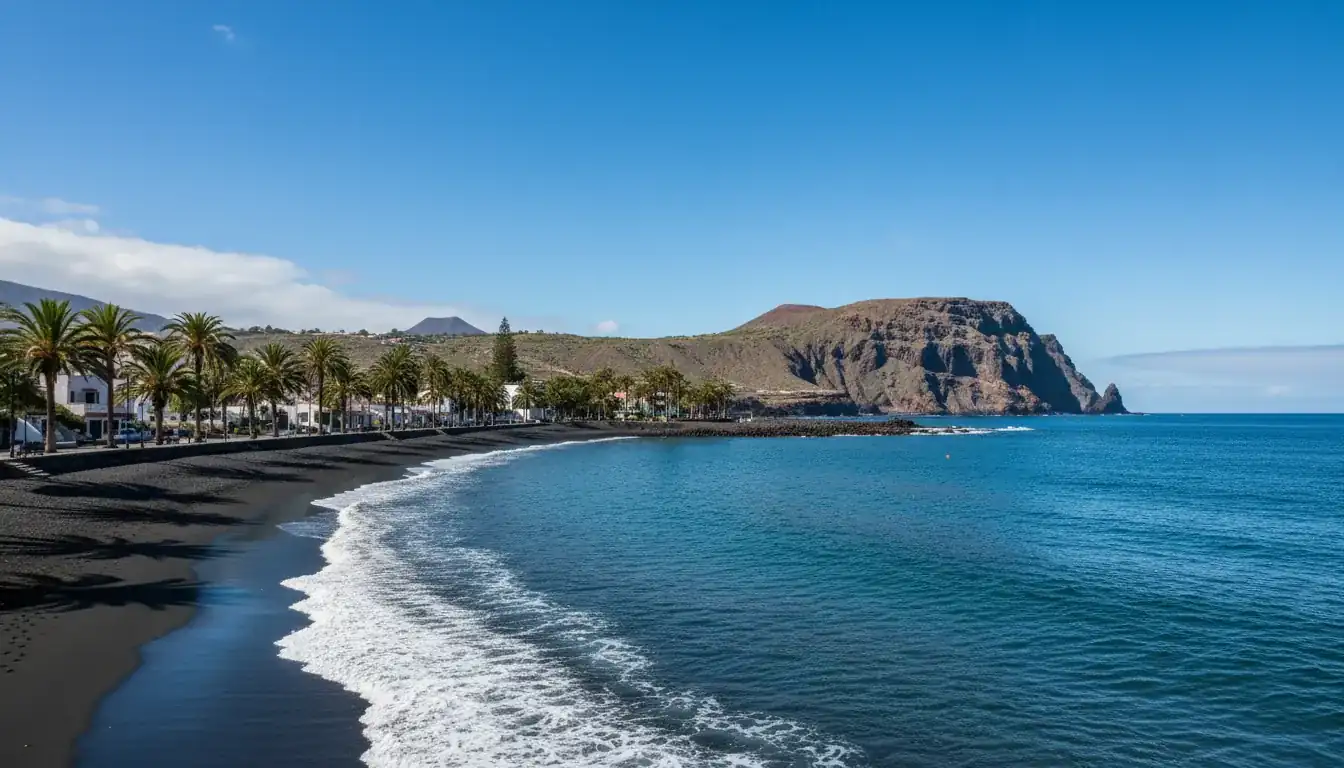
Los Gigantes Driving Tips — Steep Streets, Parking and Mountain Roads
Driving in Tenerife from Los Gigantes means different rules, steep streets and mountain roads that catch UK drivers off guard every season. This guide covers the Spanish road law changes in force for 2026, the specific hazards of Los Gigantes itself, where to park, where to fill up, and what to know before you head for Masca, Teide or Punta de Teno.
Search & Compare Car Hire Deals
Free cancellation on most vehicles
Spanish Road Rules UK Drivers Get Wrong
Drive on the right — and what that changes at roundabouts
The most disorienting difference is roundabouts. In Spain, traffic on the outer lane has priority over the inner lane when exiting — the opposite of UK convention. Yield to vehicles already on the roundabout as you enter, but when leaving, the vehicle to your outside has priority. Take an extra beat at each one until the logic is automatic.
Speed limits — including the 20 and 30 km/h urban zones
The hierarchy is straightforward but the lower urban limits catch drivers by surprise:
- Motorways (autopistas/autovías): 120 km/h
- Interurban roads: 90 km/h
- Urban roads with more than one lane per direction: 50 km/h
- Single-lane urban streets: 30 km/h
- Shared-surface streets (no kerb separation): 20 km/h
Those 30 and 20 km/h limits apply throughout Los Gigantes and Puerto de Santiago. The DGT's 2021 urban speed reform (Instrucción 2021/V-007) made them the default across Spain — they are not advisory.
Drink-driving — the limit is lower than the UK
Spain's current limit is 0.5 g/l blood (0.25 mg/l breath). England's limit is 0.8 g/l, so the Spanish threshold is considerably stricter. One standard drink — a large glass of wine or a pint of lager — is enough to push many adults over 0.5 g/l. Designate a driver and keep them dry for the evening.
A planned reform to 0.2 g/l is still in the Spanish legislative pipeline as of June 2026 and is not yet in force, but it is expected to tighten further.
The V-16 beacon — mandatory from 1 January 2026
Spain replaced roadside warning triangles with the V-16 connected emergency beacon (Real Decreto 1030/2022, reinforced by RD 450/2026). Every Spanish-registered vehicle — including your hire car — must carry one. Your rental firm should have it in the glove box; check before you leave the desk. If your car breaks down, place the beacon on the roof: it transmits your GPS position to the DGT 3.0 emergency management platform. It does not automatically call emergency services. Using a triangle instead of a V-16 carries a €200 fine. If the beacon is missing from your hire car, report it to the rental company and get confirmation in writing.
Mobile phones, child seats and Santa Cruz's low-emission zone
Phone in hand while driving: €200 fine plus six penalty points — the same penalty applies to foreign licence holders through cross-border enforcement.
Child restraints: any child under 135 cm must travel in an approved seat (ECE R44/04 or i-Size R129 standard) fitted in the rear. Your hire firm can supply one — confirm it when booking so you're not refused a seat on collection day.
Santa Cruz ZBE: the city has approved a low-emission zone but enforcement does not begin until 2029, and it covers only central Santa Cruz — not the west coast, not the resort area. Only petrol cars registered before 2001 and diesels before 2006 will be restricted. Modern hire cars are entirely unaffected. If you drive into central Santa Cruz for a day trip, carry on normally.
UK driving licence: your UK photocard licence is valid in Spain for up to six months as a tourist. No International Driving Permit is required (covered by the bilateral agreement in effect since March 2023). You would only need an IDP if you hold a paper licence.
Driving Inside Los Gigantes
Los Gigantes started as a tiny fishing community at the base of 600-metre cliffs and has fanned upward from the harbour ever since. The result is a resort built on gradients, with a one-way system that seems, as more than one traveller forum has noted, to keep throwing you out of town every time you try to navigate it. Narrow streets, blind corners and frequent tight turns are the norm.
Hill starts are a genuine challenge. The junctions on Calle San Antonio and the approach roads above the marina can slope steeply enough that a stalled manual car will roll back into traffic. If you are not completely comfortable with steep hill starts on unfamiliar roads, book an automatic transmission. Automatics remove the roll-back risk entirely and make the one-way manoeuvring considerably less stressful.
One practical problem: automatic cars are scarce on the west coast. Local operators have smaller fleets than airport-based companies, and automatics — particularly larger or family-sized ones — sell out earliest. Book two to three months ahead if you are visiting during school holidays, February half-term or at Easter. Do not assume you can arrange an automatic on arrival.
If you are arriving from Tenerife South Airport on the TF-1, leave the motorway at Exit 87 onto the TF-46 spur, then take the TF-47 north through Alcalá, Playa San Juan and Puerto de Santiago. Miss Exit 87 and you will end up heading for Guía de Isora. The final TF-47/TF-454 descent into the resort after dark is steep, narrow and poorly lit — first-time drivers should keep their speed right down.
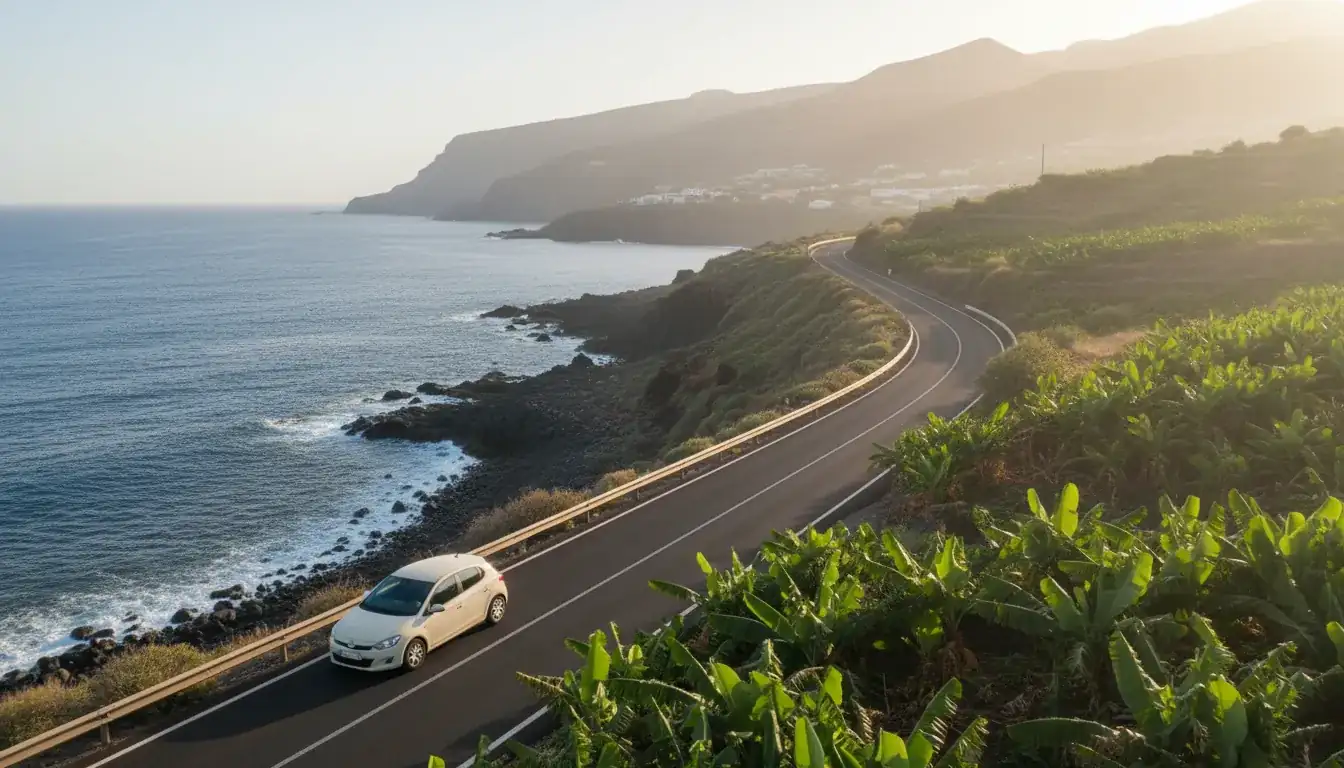
Parking in Los Gigantes
There is no public car park in the resort core. The combination of narrow one-way streets and very limited kerbside space makes parking one of the most frustrating aspects of driving in Los Gigantes, particularly around midday and at weekends when day-trippers add to resident demand. Street parking does free up in the evenings when visitors head out on foot.
Your main options:
Marina car park: approximately €1.90 per hour. It fills early on busy days; the approach involves the tight one-way system.
Private garage — parkinglosgigantes.com: the most reliable multi-day option. Check current rates and availability before you travel.
Hotel parking: factor the daily cost into your overall car hire budget before you book:
| Hotel / Property | Parking Cost |
|---|---|
| Landmar Playa La Arena (Puerto de Santiago) | ~€8/day, on-site, no reservation required |
| Royal Sun Resort | ~€10/day, private facilities |
| Barceló Santiago (Adults Only) | €20–22/day, subject to availability |
| Ona el Marqués Resort | Free public spaces nearby (availability not guaranteed) |
A €22/day hotel parking charge over a fortnight adds over €300 to your trip — roughly a week's hire from a local operator. Factor this in when comparing headline airport broker prices against the real all-in cost.
Fuel on the West Coast
Fuel prices in the Canary Islands are substantially lower than in mainland Spain or the UK because the islands pay IGIC (0–7%) rather than standard 21% VAT, plus a small Canary forestry levy. Expect to pay roughly €1.30–1.55 per litre for 95 unleaded, compared to around £1.45–1.55 per litre (approximately €1.65–1.75) in the UK at time of writing. Fill up in the west if you can — do not assume you need to save it for a cheaper station further along.
Named stations on the west coast:
DISA "Bajada a Los Gigantes"
Ctra. Puerto Santiago–Tamaimo, km 1.5. Closest to the resort.
PCAN Alcalá
TF-47, km 15. On the coastal road south.
GMOIL Adeje (Industrial zone)
Around €1.35/L at last check; worthwhile if you are passing through Adeje.
Fuel prices change daily. Before a long run — especially up to Teide — check the official government portal at geoportalgasolineras.es, which maps live prices at every registered station in Spain.
Compare Los Gigantes car hire options from local operators to find a firm with a full-to-full or fixed-fuel policy so there are no surprises on return.
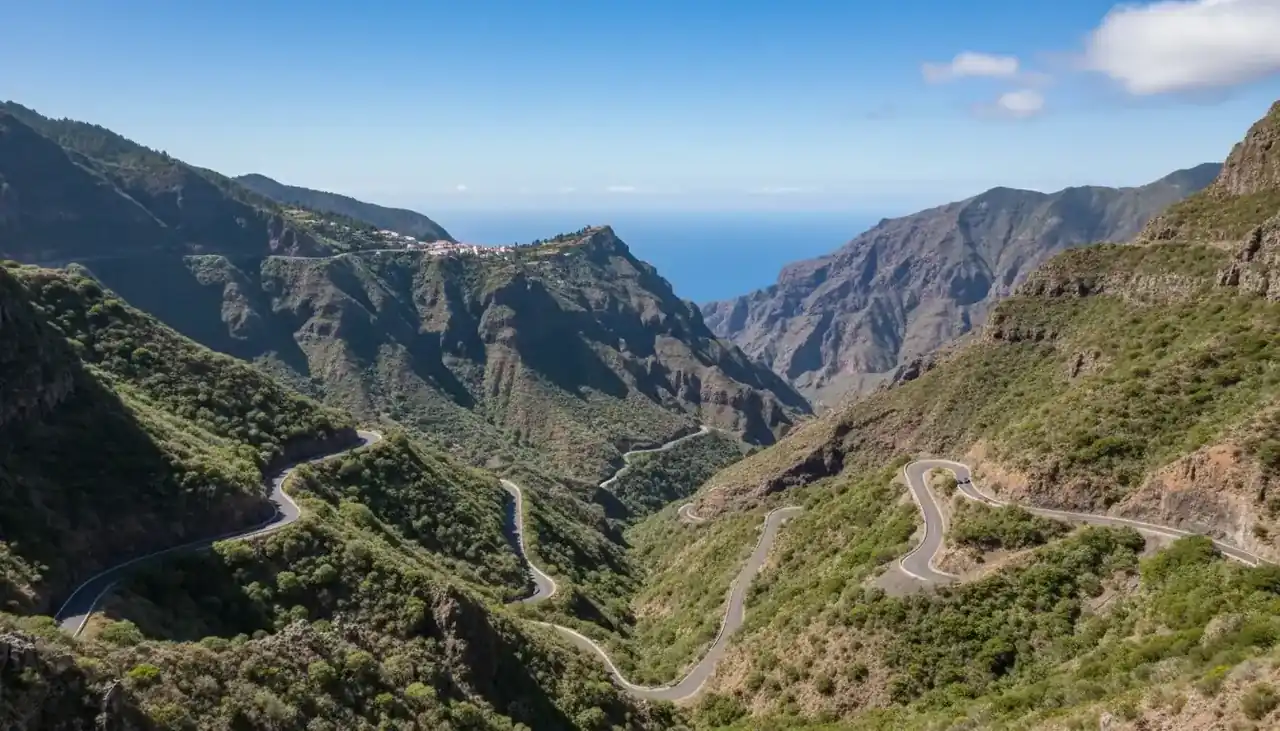
The Mountain Roads
Masca (TF-436) — hairpins and a complex access situation
The 13 km drive from Los Gigantes through Santiago del Teide and down into Masca village takes roughly 25–30 minutes but packs in continuous hairpin bends, gradients of up to about 16%, and single-lane pinch points where you will need to reverse to let a coach through. Vehicles over 10 metres are banned on TF-436; there is no general prohibition on hire cars, but check your rental firm's specific terms and conditions before driving it, as some firms exclude mountain roads from their cover.
Coaches tend to use the road in both directions around midday — early morning or late afternoon visits are quieter.
Parking at Masca village is enforced: a two-hour maximum applies between 08:00 and 14:00, and towing is in operation. Do not assume you can leave a car there while you walk down into the gorge.
The Masca Gorge hike itself requires a separate advance booking through the official site caminobarrancodemasca.com, and access is strictly regulated — 25 hikers per 30-minute slot, entry between 08:30 and 13:00, closed hiking boots enforced at the checkpoint. Descent to the gorge is by mandatory TITSA shuttle 355 from Santiago del Teide (running Fri–Sun since April 2025). Private vehicles cannot access the gorge trailhead.
See things to do near Los Gigantes for the full excursion logistics.
Teide via TF-38 (Chío route) — watch for winter closures
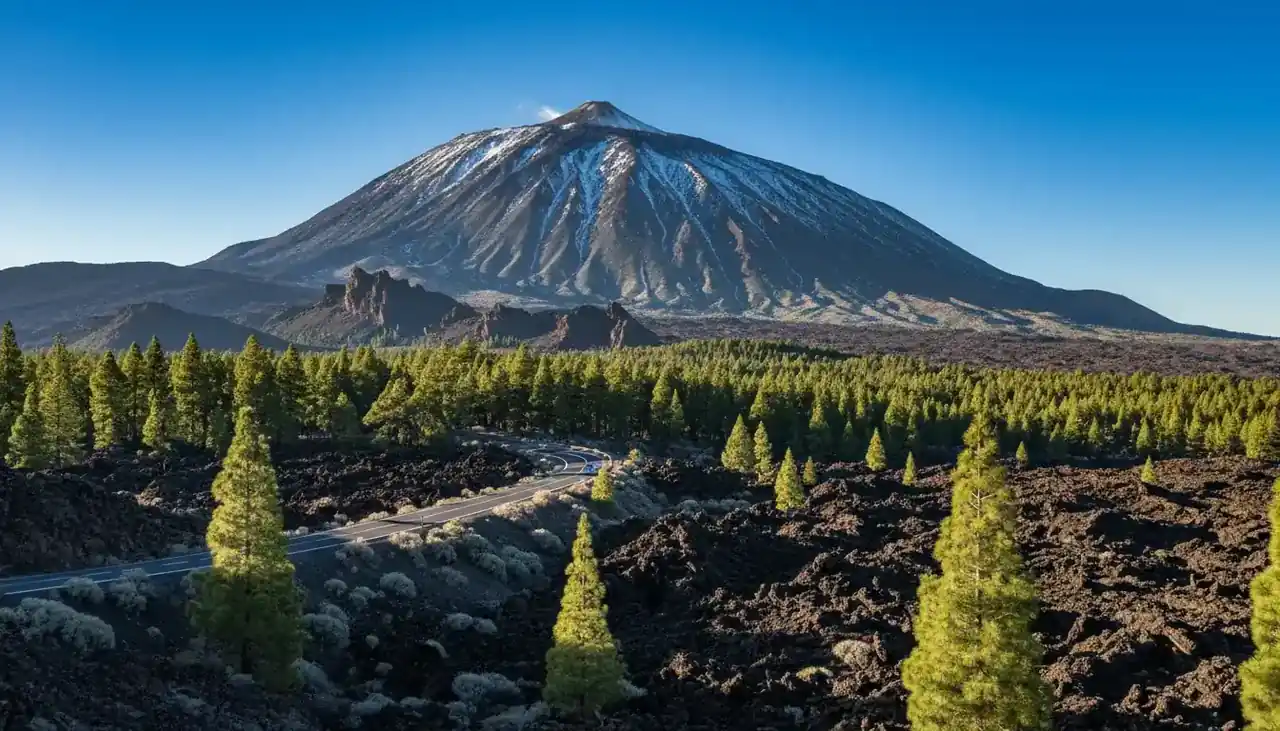
The TF-38 Chío road climbs from sea level near Los Gigantes to approximately 2,350 metres at the cable-car base — the entire height gain in roughly 55 km and around an hour's drive. The road is well-surfaced and the views over the west coast are exceptional on a clear day.
The risk is winter closures. The Cabildo de Tenerife closes the TF-38 for ice and snow several times each winter — confirmed closures occurred in December 2025, February 2026 and March 2026. This can happen with limited warning when you are sitting in 22°C sunshine at the coast and it has been snowing at 2,000 metres overnight.
Before heading up in winter (roughly November to April), check the Cabildo's road status at webtenerife.co.uk or the Cabildo de Tenerife website. When the road is open under a "snow device" order, the maximum speed drops to 50 km/h and stopping is banned outside designated bays. On the descent, use engine braking (second or third gear) rather than riding the footbrake — brake fade on a continuous 1,800-metre descent is a real risk, not a theoretical one.
The Erjos tunnel — which will cut the El Tanque to Santiago del Teide section from around 25 minutes to under 10 — is expected to open in Q1 2027. Until then, the north loop from Los Gigantes uses the TF-82 and TF-436 mountain roads, which add time and gradient to any circuit of the island.
Punta de Teno (TF-445) — buses only, no exceptions
Private cars are prohibited on the TF-445 every day of the year. This is not a seasonal restriction — it applies 365 days a year. There is no fee for getting it wrong; you will simply be turned away at the barrier in Buenavista del Norte.
To visit Punta de Teno lighthouse and the Teno coastline, park in Buenavista and take TITSA bus 369 (approximately €1 per journey, around 20 minutes each way).
Additional complication for 2026: roadworks on the TF-445 began 19 January 2026 for a 10-month programme funded by Next Generation EU (budget over €1.6 million). The end date is not officially fixed but the implied timeline is around November 2026. During works, the shuttle bus is the only access. Check buenavistadelnorte.travel for the latest status before you plan this trip.
Distances from Los Gigantes
All figures are indicative — road distances and times vary by traffic, road conditions and route choice. The table gives a practical working estimate:
| Destination | Approx. Distance | Approx. Drive Time |
|---|---|---|
| Tenerife South Airport (TFS) | 42 km | 35–40 min |
| Tenerife North Airport (TFN) | 90 km | ~1 hr |
| Playa de las Américas | 30 km | 25–30 min |
| Los Cristianos | 33 km | ~30 min |
| Costa Adeje | 28 km | ~25 min |
| Masca village | 13 km | 25–30 min |
| Santiago del Teide | 10 km | ~15 min |
| Garachico | 30 km | 40–45 min |
| Icod de los Vinos | 35 km | ~45 min |
| Teide cable car (via TF-38, Chío) | 55 km | ~1 hr |
| Puerto de la Cruz | 62 km | 50–60 min |
| Santa Cruz de Tenerife | 95 km | ~1 hr 10 min |
Garachico has very limited central parking — leave the car on the seafront and walk. The Erjos tunnel opening in Q1 2027 will shorten journey times to the north considerably.
If Something Goes Wrong
Emergency number: 112 covers police, ambulance and fire throughout Spain.
Accident procedure: hazard lights on, stop safely, deploy the V-16 beacon on the roof from the door (do not step onto a live carriageway). Call 112 if anyone is injured. Photograph all vehicles and the scene before moving anything. Use your rental firm's accident report form rather than a generic European Statement — some Spanish insurers require the rental company's own paperwork.
V-16 deployment: the beacon transmits your GPS position to DGT 3.0 traffic management and alerts passing drivers. It does not call 112 automatically — make that call yourself.
Breakdown: your rental firm's 24-hour roadside assistance number should be in the glove box. Most local west-coast operators (Cicar, Las Rosas, SantiagoRent) include roadside cover as standard — confirm this when you collect the car.
Ready to compare car hire deals in Los Gigantes?
Check live prices and availability from local and international suppliers.
Compare car hire deals